



What Is the Matismart MT61
The MT61 is an “all-in-one” device family from the Chinese manufacturer Matismart, combining a circuit breaker, a residual current protection device (in the MT61GR version), an automatic reclosing (AR) function, an energy meter, a communication module, and a remote control unit — all in a single enclosure.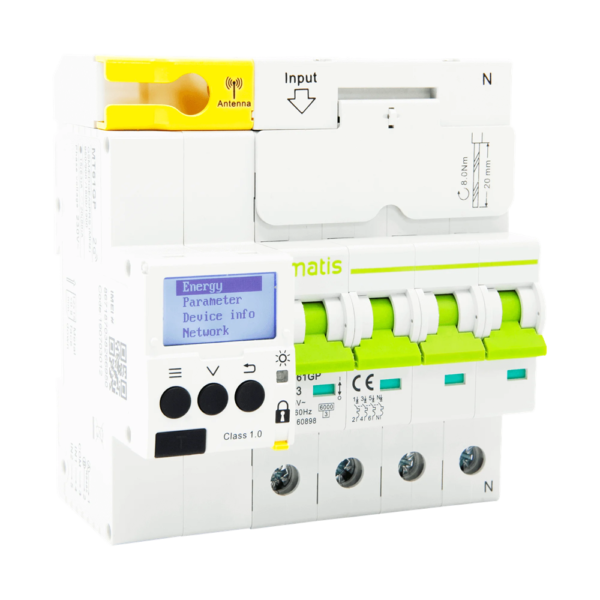
The device is DIN-rail mounted and is designed to address electrical protection, energy metering, and load management tasks.
Integration with metering systems and SCADA is achieved via RS-485 with the Modbus RTU protocol, as well as via built-in WiFi and GSM modules using the MQTT protocol.
Modifications and Model Designations
The lineup consists of two base families — MT61GP and MT61GR — differing in whether they include built‑in residual current (earth leakage) protection. The MT61GP denotes the base version without RCD/RCBO. The MT61GR adds an electronic leakage protection module (RCBO) with adjustable trip current settings of 30mA/100mA/300mA/500mA, which can be configured via the front LED screen.
Note that the leakage test button on the front panel is physically present on both modifications, but on the MT61GP the leakage-testing function is not implemented — pressing this button on the GP version will not trigger a residual-current trip.
MT61GP/GR is available in 2‑pole (single‑phase) and 4‑pole (three‑phase) configurations. Rated current for these models ranges from 16 to 80 A. If higher current ratings are required, refer to Matismart’s MTM5‑EL and MT88M devices.
Metering Functions
In terms of energy metering functionality, MT61 devices are suitable for energy monitoring and provide comprehensive, high-accuracy measurement of electrical parameters:
- Bidirectional multi-tariff energy metering: active energy accuracy Class 1, reactive energy accuracy Class 2.0. Supports up to 4 time-of-use tariff zones.
- Instantaneous values: voltage, current (per phase), active/reactive/apparent power, power factor, frequency.
Maximum/minimum values: logging of extreme values with timestamped alarm records (not currently used in the Amivisor implementation). - Load profile information: the manufacturer states that MT61 calculates current and peak demand for power and current based on a sliding 15-minute window. However, MT61GP has no internal load-profile storage. Interval data is generated either on Matismart’s cloud platform (via the G30 gateway) or within Amivisor, based on hourly polling of readings over RS-485.
Note: revenue billing applications require metering hardware with appropriate regulatory certification.
Practical application of metering functions:
This device is suitable for energy monitoring and sub-metering. By connecting it to Amivisor, you can accumulate consumption data and track voltage and load levels. The system will notify you via the mobile app and email whenever configured voltage, current, or power limits are exceeded.
Protection and Auto-Reclosing (AR) Functions
The MT61 implements a full suite of digital electrical protection based on an embedded microcontroller (MCU), where the tripping decision is made by digital logic and the tripping action itself is carried out by a built-in motorized actuator — not a conventional thermal/magnetic trip element.
- Voltage protection: overvoltage (default threshold 275 V, adjustable 265–350 V), undervoltage (default 160 V, adjustable 100–200 V)
- Phase loss protection: threshold 20 V (adjustable)
- Overload and short‑circuit protection: the device continuously monitors current over time, modeling the thermal heating of conductors and loads, and trips the circuit when a fault condition is approaching.
- Residual current protection (MT61GR only): adjustable residual current sensitivity with trip current settings of 30 mA, 100 mA, 300 mA and 500 mA, with selectable operating modes “Alarm” or “Trip” (see below).
- Overtemperature protection: built-in overheating monitoring
- Phase imbalance protection: three-phase models only
All parameters above can be configured using the manufacturer’s configuration software.
Important clarifications:
- Current-based tripping is executed via a motorized actuator on command from the microcontroller, rather than directly by a thermal/magnetic trip mechanism as in conventional circuit breakers.
- The device supports auto-reclosing (AR) functionality: for each protection type, one of the following actions can be configured — Alarm, Open (trip with subsequent auto-reclose), or Lock (reclose blocked).
- By default, all protections ship from the factory with the “Trip” (Open) action configured. Before commissioning, it is recommended to verify protection settings and AR programs using the configuration tool.
- Automatic reclosing should only be used for temporary faults after a site-specific risk assessment, taking into account load characteristics, fault type, personnel safety and applicable local electrical regulations. It must not be relied upon as an unattended substitute for manual inspection after earth-leakage, electric-shock-related or short-circuit events.
Auto-reclosing programs:
AR is configured separately for current-related faults (SRM) and for residual-current faults (SRD):
- MT61GP/GR — current faults (SRM): 8 programs (RM0–RM7), up to 2 reclosing attempts with intervals from 30 sec to 3 min
- MT61GR — residual current faults (SRD): 12 programs (RD0–RD11), up to 30 reclosing attempts with intervals from 20 sec to 16 min
Once the number of reclosing attempts is exhausted, manual intervention is required.
Note on 110 V / split‑phase networks:
In many Latin American countries, as well as in the United States and Canada, low‑voltage distribution is based on a split‑phase topology that delivers approximately 110–120 V line‑to‑neutral on each leg and 220–240 V line‑to‑line.
In this configuration, the MT61GP/GR can operate correctly on a 110–120 V system, but the over/under‑voltage protection must be disabled, because the factory under‑voltage threshold (160 V) is above the nominal 110–120 V level and would otherwise cause unwanted trips. With voltage protection disabled, all other core functions — energy metering, remote control and the remaining protections (overload, short‑circuit, residual‑current) — continue to work as expected.
For projects where full over/under‑voltage protection at 110–120 V is a strict requirement, Matismart can provide a customized hardware/firmware variant, subject to bulk‑order conditions.
Practical application of protection and AR functions:
The device provides protection across all key parameters, disconnecting power both in the event of an impending fault (overload, over/undervoltage) and in the event of an electric shock hazard (ground-fault tripping). This makes MT61 well suited for remote, unattended sites (telecom towers, base stations, EV charging stands) — following a protective trip caused by a temporary fault, the device can reclose automatically according to the configured AR program, reducing the need to dispatch personnel for routine resets. As noted above, AR settings should be configured based on a site-specific risk assessment.
Load Management and Digital I/O
Remote on/off switching (remote breaker open/close control) can be performed either through the manufacturer’s mobile app and cloud platform, or via the Modbus RTU protocol when integrated with third-party systems such as Amivisor.
The configuration software allows scheduling of automatic on/off switching at defined times.
The device is equipped with a mechanical lockout feature to protect personnel during maintenance. A physical “safe operation lock” is provided on the front panel.
The device has 2 digital inputs, configured by default as one dedicated ON input and one dedicated OFF input for remote breaker open/close control from external dry-contact devices. Note: standard analog sensors cannot be connected directly to these inputs. External thermostats or controllers with a dry-contact or relay output should be used instead.
Practical application of load management functions:
The device is suitable for automatic load control based on a predefined schedule. Consider a practical example — automation of an electric heating boiler:
- By configuring on/off schedules, you can restrict boiler operation to low-cost, off-peak tariff hours.
- However, the device’s internal clock has a certain drift, and time may shift over time, leading to overpayment if the boiler runs during peak-tariff hours. To ensure the boiler switches precisely in line with the commercial meter’s tariff transitions, it is recommended to connect the device to Amivisor, which maintains accurate time synchronization for the device’s internal clock.
- By connecting an external thermostat or temperature controller with a dry-contact or relay output to DI1/DI2, boiler operation can be automated based on its signal — for instance, forcing the boiler on during cold conditions regardless of the current tariff zone.
Communication and Platform Integration
The standard interface is RS-485 with the Modbus RTU protocol. This interface enables connection of external communication devices (such as a GSM modem) for data collection on the Amivisor platform.
Optionally, the device can be equipped with a WiFi, 4G, or GPRS module, enabling operation over the MQTT protocol.
MT61 has a pulse output that emits pulses proportional to increments of active energy consumed, rather than providing direct meter register readings. In theory, this allows connection of an external pulse counter, but this method of data collection is not recommended, as it only provides total energy consumption data while all other device functions remain inaccessible.
Practical application of communication functions:
The device features an open communication protocol and can be used with either the manufacturer’s own software or third-party platforms.
Typical Wiring Diagram
In its basic configuration, MT61 is installed in series with the supply line, simultaneously acting as the incoming breaker and the meter. Power terminals follow the standard layout: the upper terminals are the supply-side input, and the lower terminals are the load-side output. For single-phase wiring (2-pole version), the device breaks the phase and neutral conductors; for three-phase wiring (4-pole version), it breaks all phase conductors and the neutral.
The RS-485 interface is implemented on a separate terminal pair (A/B). In a typical setup, this pair connects to an external communication device — such as a GSM modem, an Ethernet-to-RS-485 converter, or a controller — which handles data exchange with Amivisor.
Digital inputs DI1/DI2 connect to dry contacts or outputs of external devices (relays, thermostats, controllers). Contact closure/opening is interpreted by the MT61 as a command or event according to the configured logic.
Amivisor Platform Support
Support for MT61GP/GR devices (via the RS-485 interface with polling through external communication devices over the Modbus RTU protocol) has been implemented on the Amivisor platform.
The current implementation supports:
- Reading instantaneous values (U, I, P, Q, S, PF, f)
- Reading active and reactive energy meter readings
- Time synchronization on the device
- Remote breaker open/close control (on/off switching)
Practical application of Amivisor platform functions:
You can rely solely on the manufacturer’s software, but connecting MT61 to Amivisor provides the following additional capabilities:
- Operate on a single unified platform alongside meters from other manufacturers: the platform is not tied exclusively to Matismart hardware and supports a broad range of metering devices.
- Configure and receive alerts on deviations of consumption parameters (U, I, P, Q, S, etc.) from defined limits.
- Analyze energy consumption both in kilowatt-hours and in monetary terms.
- Support interval (hourly) energy metering.
- Analyze consumption by production shift.
- Track the operating states of machines and equipment connected via MT61, to determine downtime duration and normal versus fault operation periods.
- Maintain accurate time synchronization on MT61.
- Build hourly energy balances across multiple meters to identify losses.
- Provide data access to other staff members.
- Use API integration to exchange data with other information systems.
When to Consider MT61 + Amivisor
Matismart MT61 devices are well suited for applications that require combining protection, metering, and remote load control within a single enclosure — ranging from small distribution panels to remote sites with limited personnel access. The Amivisor platform complements these capabilities with end-to-end analytics, alerting, and a unified interface for working with equipment from multiple vendors.
If you are already using Amivisor and are planning to deploy smart breaker-meters, MT61 can be a strong candidate for a pilot project. If needed, we are ready to share deployment experience, typical wiring schematics, and recommendations for configuring device polling within your existing infrastructure.
For organizations just beginning their journey toward energy metering and load-control automation, the MT61 + Amivisor combination allows for a gradual progression — from basic monitoring to more advanced use cases such as shift-based consumption accounting, equipment downtime tracking, loss analysis, and integration with corporate metering systems.